Welcome to the Cyprus Guide!
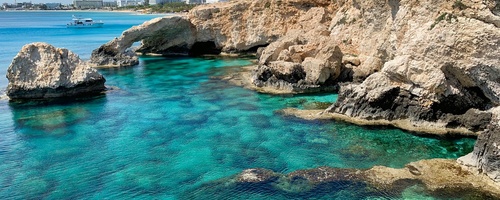
Cyprus is an EU country of about 997,000 people in the government-controlled south, where English is widely spoken. It suits EU citizens and non-EU workers sponsored by an employer, but many hotel jobs end in winter.
Who hires
Cyprus had 280 hotels in January 2026, mostly in Paphos, Ayia Napa, Limassol and Protaras. Tourist arrivals are about 6% lower so far in 2026, since the regional war began.
EU, European Economic Area and Swiss citizens need no work permit. Line jobs go to non-EU workers only if no Cypriot or EU worker is available: the employer advertises locally, then applies for your permit.
When hiring happens
The busy season is April to October.
Where you live and what it costs
Pay is in euros (EUR). The minimum wage is EUR 1,088 a month before deductions in 2026 and 2027 (about USD 1,200), and EUR 979 (about USD 1,080) in the first 6 months with one employer. Some hotel jobs have their own minimum wage under a 2025 decree: EUR 965 to 1,187 a month for a 38-hour, five-day week, service charge included (about USD 1,060 to 1,310). Hotels must pay a 13th salary by 20 December, in proportion to time worked. In 2025, non-Cypriot hotel and restaurant staff averaged EUR 1,495 a month before deductions (about USD 1,640).
A hotel that hires you on a work permit must provide housing. Crowd-reported prices (November 2026) put a one-bedroom flat in Paphos at about EUR 820 to 1,145 a month (about USD 900 to 1,260). The same reports put a cheap restaurant meal at about EUR 15 (about USD 16).
Daily life
In hotels the legal maximum is 48 hours a week, overtime included. Drug laws are strict, cannabis included.
Getting there and around
The airports are Larnaca and Paphos. Buses link the towns. Entering Cyprus through the north counts as illegal entry; cross only at official crossings.
What to watch for
- A work permit ties you to one employer. You can change up to three times, in the same sector and job, with your employer's release. Seasonal workers can also change after a labour dispute decision.
- Recruitment agencies need a Labour Department licence and may not charge you fees, collect your pay or keep your passport or permit papers.
- Keep your passport. Keeping a worker's passport to exploit or control them is a crime.
- Inland summers are very hot: Nicosia reached 43 °C in July 2026. Wildfire risk is high from April to October. Call 112.
- Read your own government's travel advice for Cyprus before you travel.
Never pay anyone for a job offer or a visa.
Before you apply
Below this guide, "Can I work in Cyprus?" gives the answer for your passport, and "What the job usually comes with" covers housing, meals, flights and leave.
Can I work in Cyprus?
Never pay anyone for a visa or a job offer. A real employer pays the permit costs and never asks you for money.
How it works
How it works: The employer first advertises the job locally; if no Cypriot or EU worker fits, the Labour Department approves and the Migration Department issues the permit.
Watch for: Unions said in August 2026 that some hotels use agencies that pay permit workers by the hour, outside the hotel agreement; check who your employer is.
Official source: Department of Labour: Application Examination Procedure (non-EU workers). Checked November 2026.
What the job usually comes with in Cyprus
Usual for Cyprus, varies by employer. Checked November 2026.
| Housing | Employer must give acceptable housing; up to 10% of pay may be deducted (permit criteria, 1991) |
|---|---|
| Meals | Food is optional; if given, up to a further 7.5% of pay may be deducted under the Labour Department hotel contract (the 1991 permit criteria allow 15%); otherwise housing needs a kitchen |
| Flights | Employer pays the trip from your home country and lodges a bank guarantee for your return |
| Service charge | 10% added to bills and shared monthly among hotel staff by points (by law) |
| Contract | Written contract stamped by the Labour Office; seasonal work up to 4 months, extendable by 4 more; hotels must pay a 13th salary (one month's pay) by 20 December, in proportion to time worked (by law since 1 August 2025) |
| Leave | 4 weeks paid: 20 working days on a 5-day week, 24 on a 6-day week (by law) |
| Income tax | 0% up to EUR 22,000 a year, then 20% to 35%; plus 8.8% social insurance and 2.65% health contribution |
Senior staff often get more than line staff, for example a single room or a yearly home flight. Ask the employer what the job includes before you accept.
Guidance, not legal advice. Rules change; your employer confirms the details for your case.